Silence in Time
Min-hyung Kang
Silence in Time
March 30, 2026
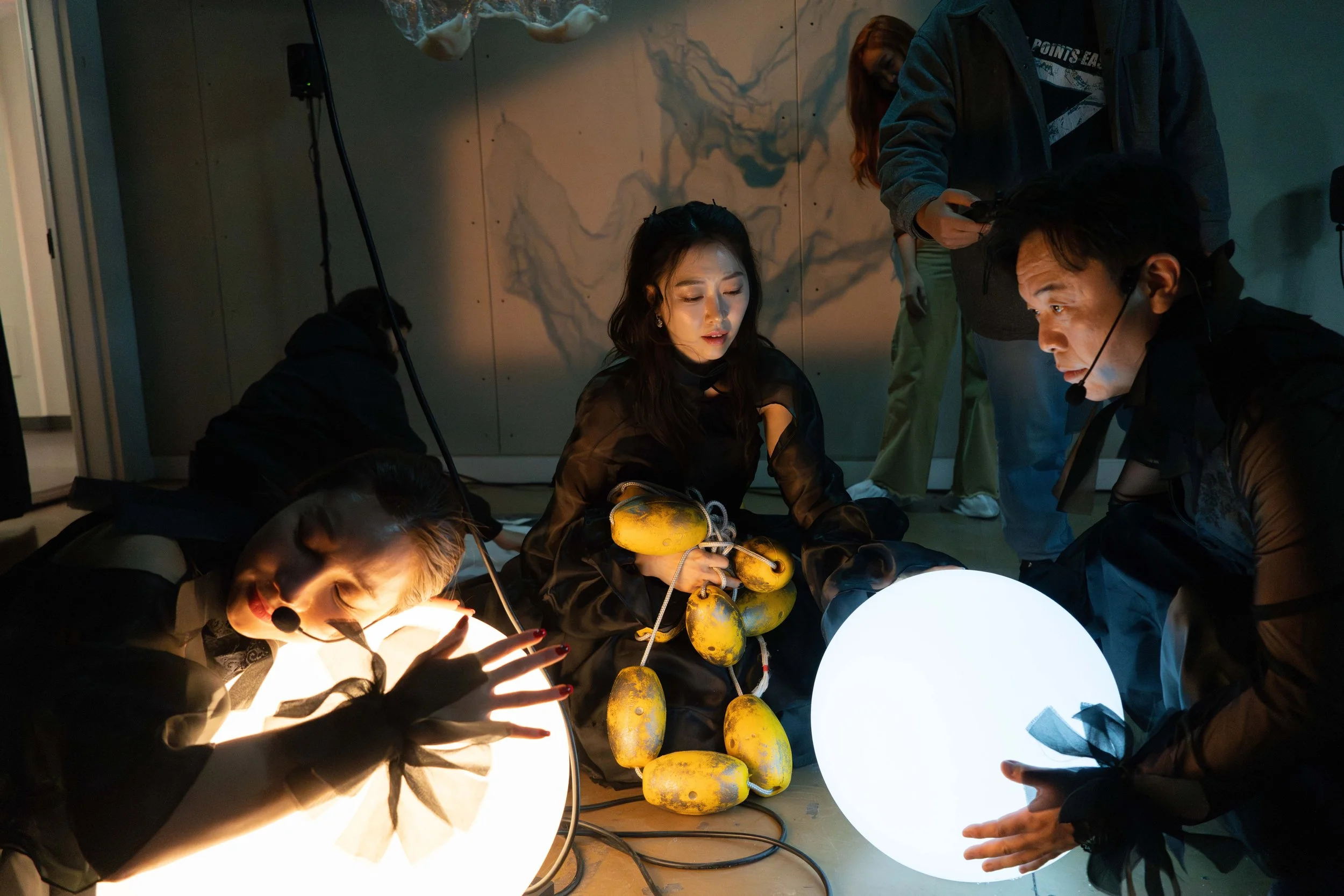
Photo by Ji Hoon Kim
On a January winter afternoon, I entered the Community Arts Space at La MaMa Experimental Theatre Club near Bowery, with my shoes soaked in slush and my cheeks burning from the cold. Having visited La MaMa before, specifically the Ellen Stewart Theatre, I anticipated a similar atmosphere as I pushed the door open.
“Wear these covers over your shoes and go up to the third floor,” a staff member said unexpectedly. Was it because everyone’s shoes were slushy? Only later did I realize it might have been because there were no seats, and people would soon be sitting wherever they could—on the floor or wherever space allowed—among small, fragile objects scattered across the theater that needed protection. After following these unexpected instructions, I stepped into the elevator. In front of me was the name of the performance in capitals, HEARING TIME IN SILENCE, surrounded by the words Concerto, Rendezvous, and Universe. The unusually quiet, slow ascent of the spacious elevator may itself have been a kind of sign, much like the shoe covers.
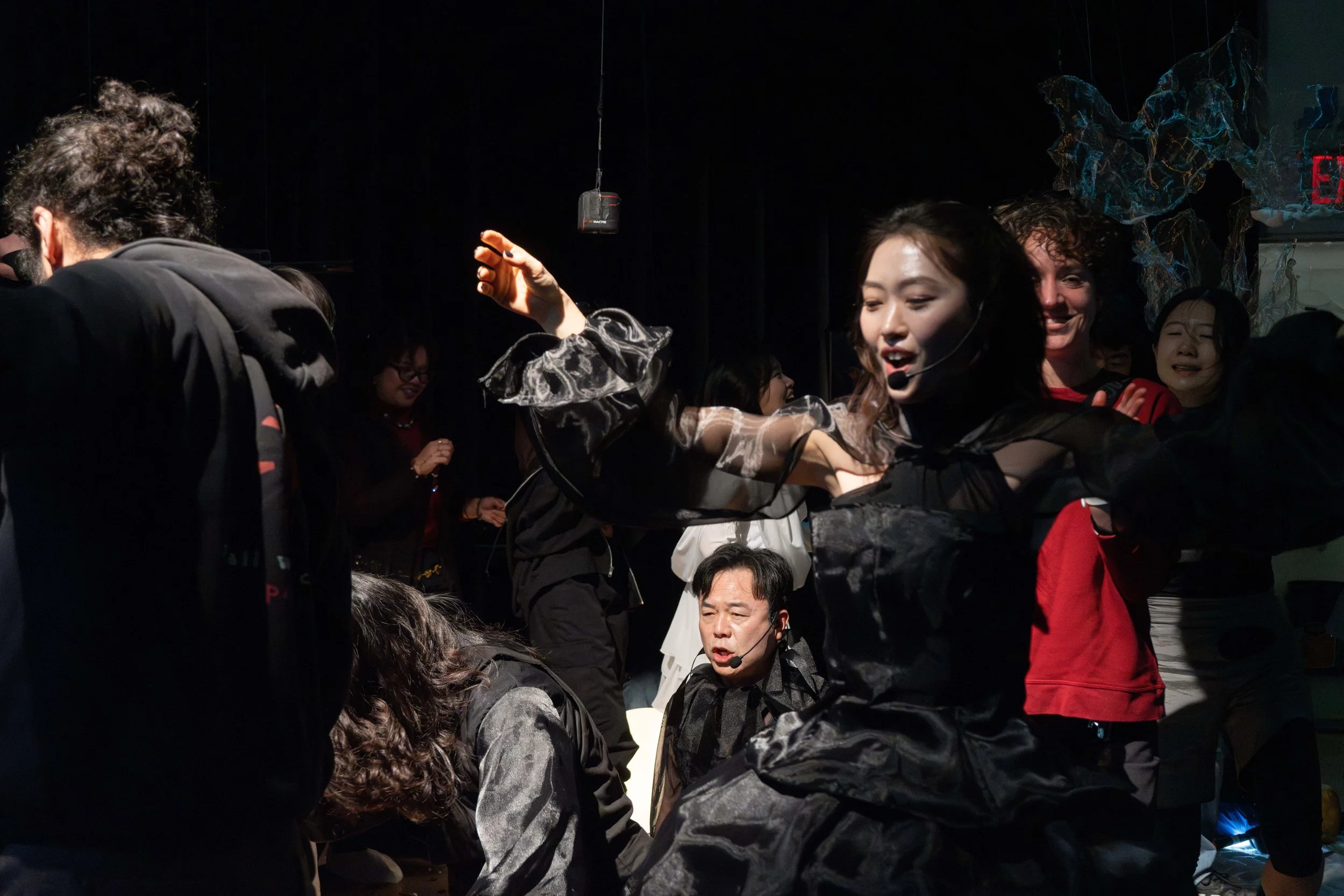
Photo by Ji Hoon Kim
The elevator stopped on the third floor, where I heard the faint sound of a classical soprano voice drifting from somewhere in the distance, although the singer was nowhere to be seen. To the right was a darkened space; to the left was something resembling a cozy sitting room filled with small, delicate objects—empty bottles, balls, and various everyday items of unknown purpose arranged within it. As is typical in most theaters, I instinctively tried to grasp the rules I was supposed to follow, such as where to sit and where to watch from, but at that moment, I heard a woman’s voice behind me. She was singing in a high register, accompanied by a violinist. As I stood in front of the elevator, she approached me, then—turning neither left nor right—disappeared down the staircase on the opposite side. I walked to the right into a relatively spacious area that had looked dark from the elevator.
I found myself among a dozen other people, standing like me, who hadn’t been guided to a seat. No singing voices could be heard there, but some people, presumably actors, lay on the floor. Another group, presumably audience members, was touching and interacting with the small props scattered throughout the space: nets hung from the ceiling, glowing stone-like lights, and a drum. Within about ten minutes, the lack of distinction between actors and audience had become clear—we were all mixed together.
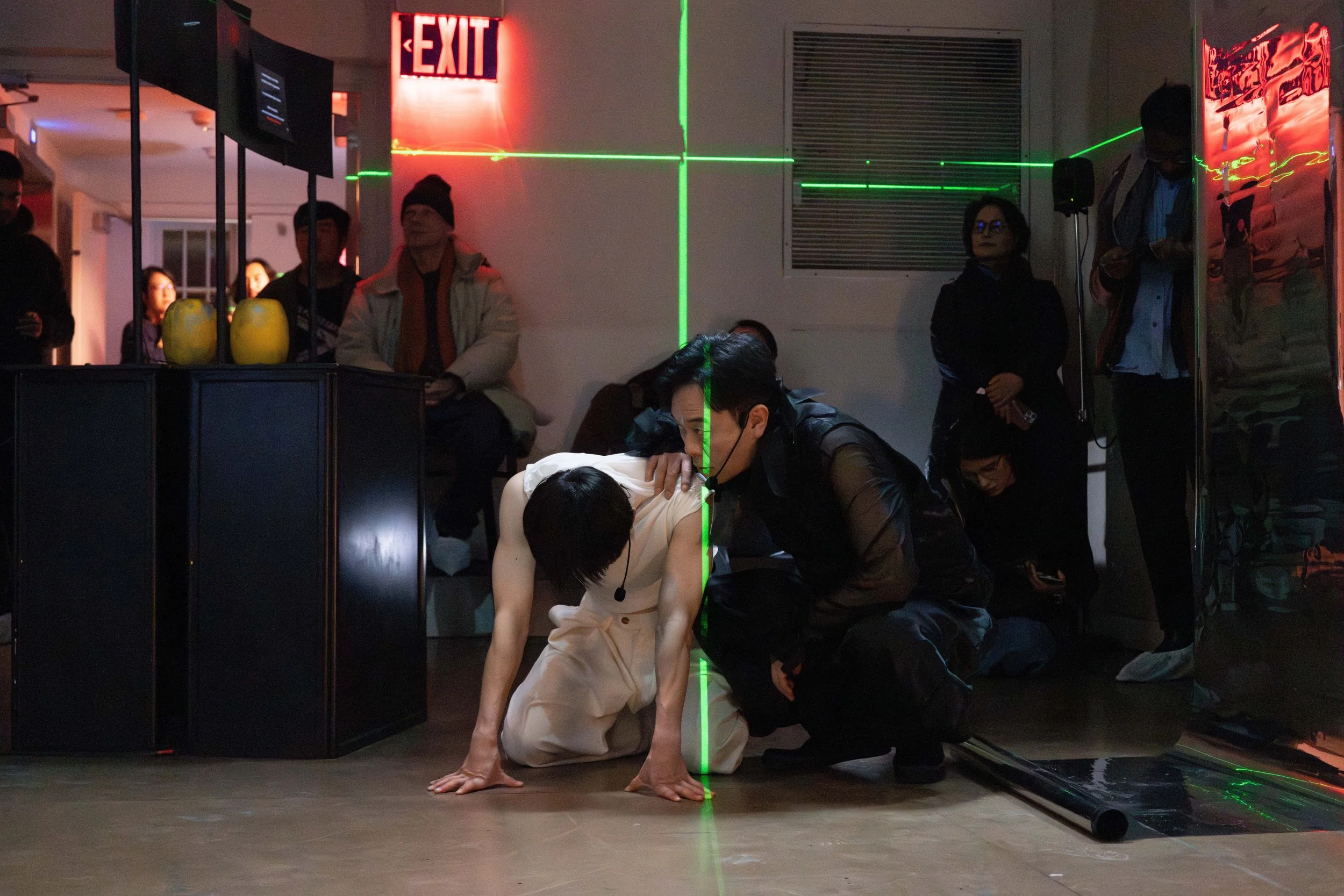
Photo by Ji Hoon Kim
Those who have read the director’s note or the critics’ essays, or seen the performance, will know that there are neither assigned seats nor a clear narrative here. While various deconstructive aesthetics are present in theater, director Choi Boomi explains this work through the lens of autopoiesis. In an interview, Choi says her opera functions like an autopoietic artistic organism. Its score, script, stage directions, and media systems are not fixed “answers” but a set of rules, allowing each performance to generate different outcomes. It also gives the work its identity across patterns of movement rather than a single version. That is, the theater itself is considered a living entity, inspired by object-oriented ontology. Light, sound fields, objects such as bottles, fabrics, and metal structures, software patches, and even audience movement are treated as equal actors, highlighting a multilayered simultaneity of beings experiencing time in different ways.
Under this philosophy, the multiverse, multiple existences, and multiple elements become central to the piece. First, unlike traditional theater, no consistent narrative drives the work. Instead, the performance unfolds through gibberish, articulated sounds, nonverbal vocalizations—breaths, moans, laughter, and cries—and the numerous noises the body produces. Second, the language is subtle. The piece, created and produced in Incheon and Seoul, South Korea, and presented in New York, USA, was performed without translation or interpretation. Language barriers and an unpolished narrative were placed at the center of the work. The loud sirens from the street occasionally reminded us that we were in New York.
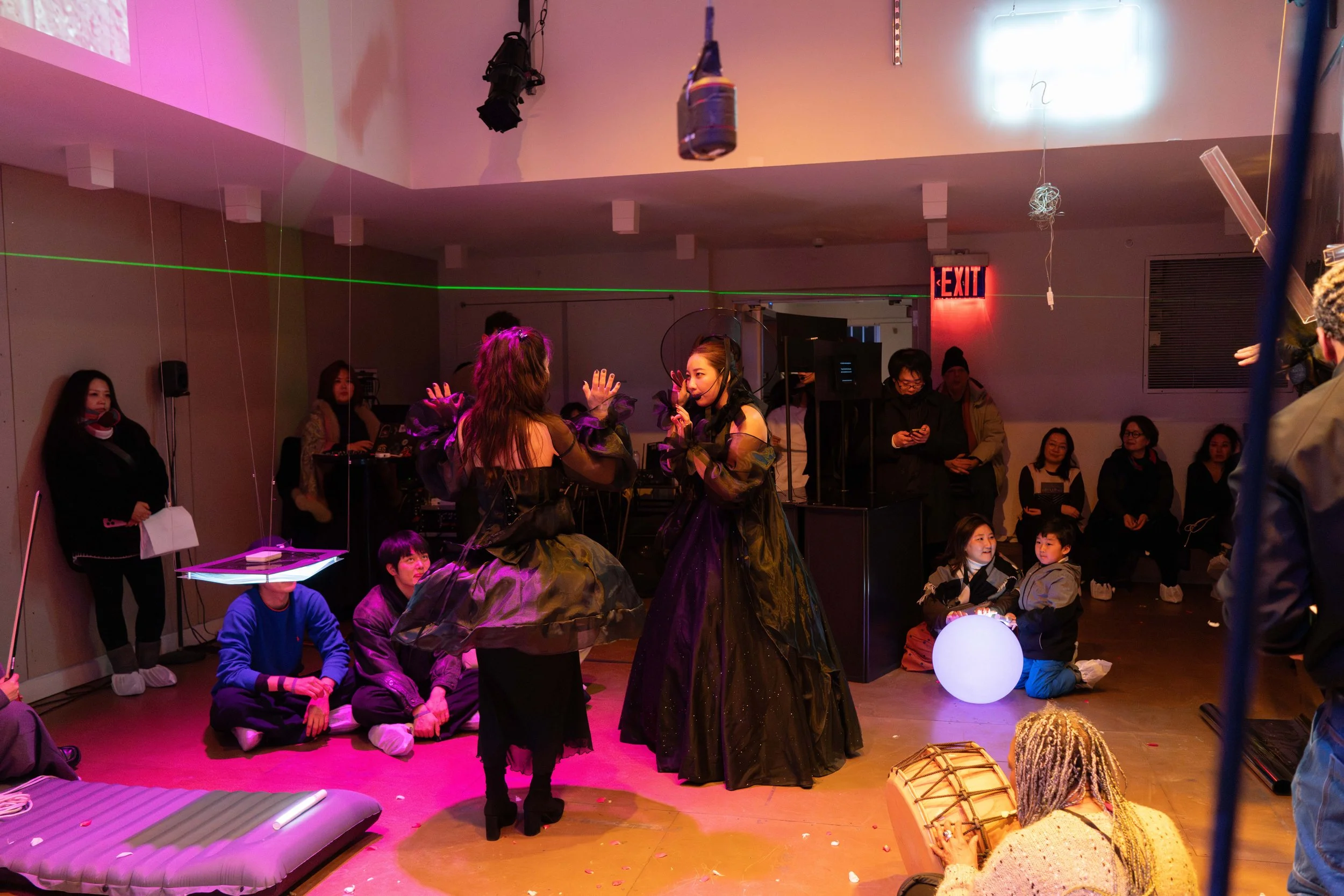
Photo by Ji Hoon Kim
Third, the music also unfolded nonlinearly, drawing on Baroque opera’s concertato spirit, jazz’s improvisation over a repeating harmonic cycle, and blues-swing grammar, and the ritual heterophony of Korean sinawi and gut. They are edited in a spirit of overlapping and improvisation. Despite these many influences, Choi still calls Hearing Time in Silence an “opera,” a deliberate challenge to traditional hierarchies where composers, conductors, and directors hold authority. She believes the presence of trained opera singers in the performance underscores the genre’s recognition, even as the work explores deconstruction and collaborative creation. Finally, movement and counter-movement coexist. In those frequent moments when performers physically engaged with the audience, we were reminded that this was still theater, even though we sometimes felt lost and distracted. Overreacting was, in fact, the right response. Someone I perceived as a performer invited me to hold their hand, but I had to question whether that invitation truly originated from the performer. Only active communication existed here, and observation was not the audience’s role. I tried to stay as passive as possible, yet even the meaning of passivity soon disappeared.
On the other hand, despite the piece’s deconstructive and reconstructive nature, there were clearly theatrical moments when all performers moved in synchronized choreography or made strong and undeniably attention-grabbing gestures and sounds. They collided, attacked, or embraced each other aggressively, or sometimes simply stared at one another. These interactions occasionally produced loud sounds, suggesting emotional intensity or desire. At times, they appeared as couples, rivals, or enemies. From this emerged a grammar typical of a thriller. In the music, in the movements, in the breakable props placed between performers—loosely tangled threads, sheer cloths, dim lights, and small pieces of paper—we could recognize the familiar syntax of tension and the ominous sense that something was about to happen.
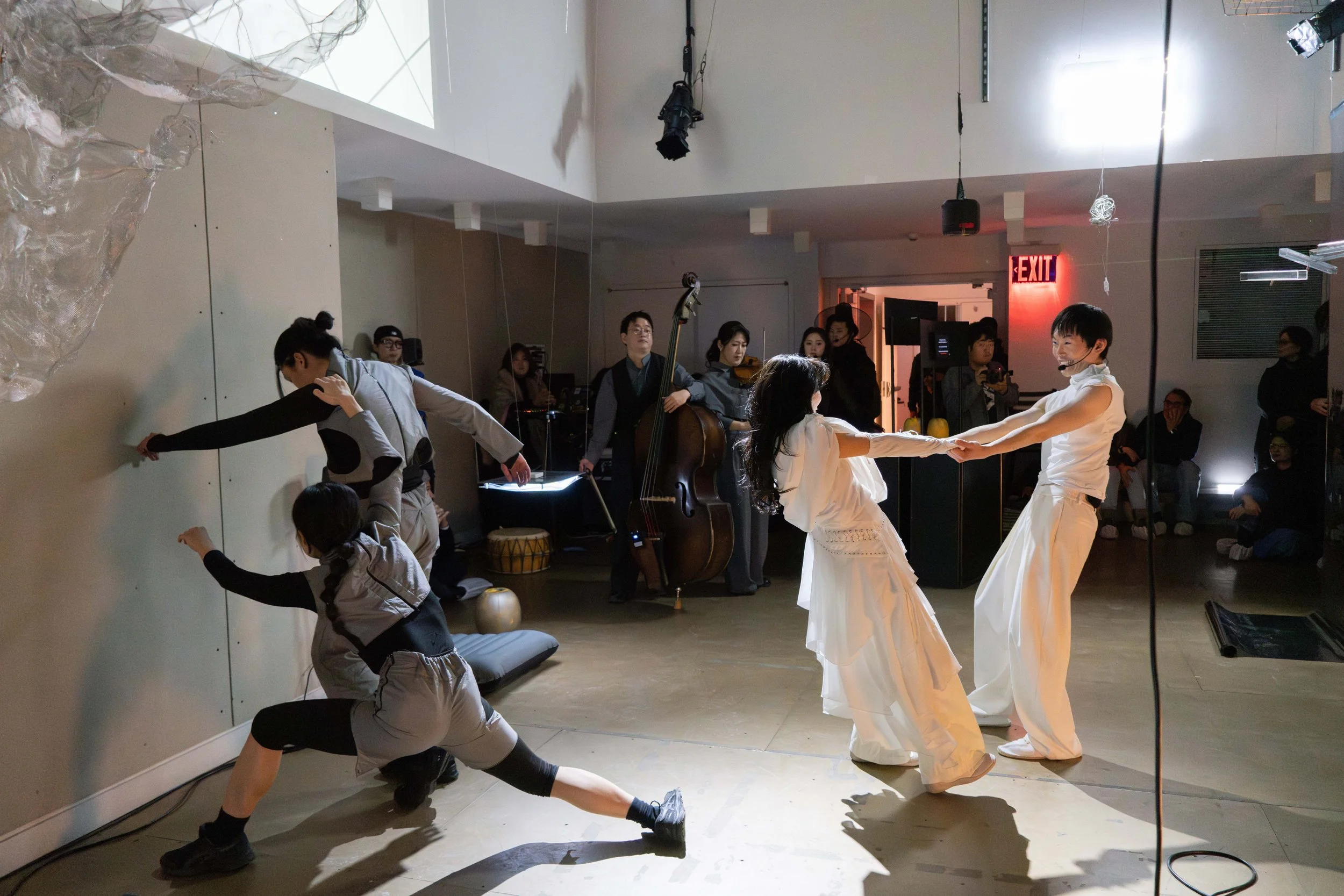
Photo by Ji Hoon Kim
However, much subtler expressions also emerged through gestures, language, and song. The performers walked past each other, held hands briefly before letting go, whispered, and sang almost imperceptibly. They pretended that they were not actors or musicians, but members of the audience. But unlike a true thriller, while each scene was powerful, the links between them were tenuous. As experienced and sometimes faithful audience members, we are accustomed to intuitive storytelling. We may have tried to connect the scenes, to assemble all the elements Choi describes as existing within a multiverse, until we eventually realized that such an effort was unrewarding, as she intended.
Now, most importantly, we need to think about time—a crucial element of this performance. This work, with its aim of reexamining the hierarchy among performers, audience, and objects while constructing a new operatic ecology, treats narrative and music as forces that encapsulate both performers and the audience in time. It gives us the impression that time is slightly misaligned, prompting the question: what is an ensemble, and how far can an ensemble be un-ensembled?
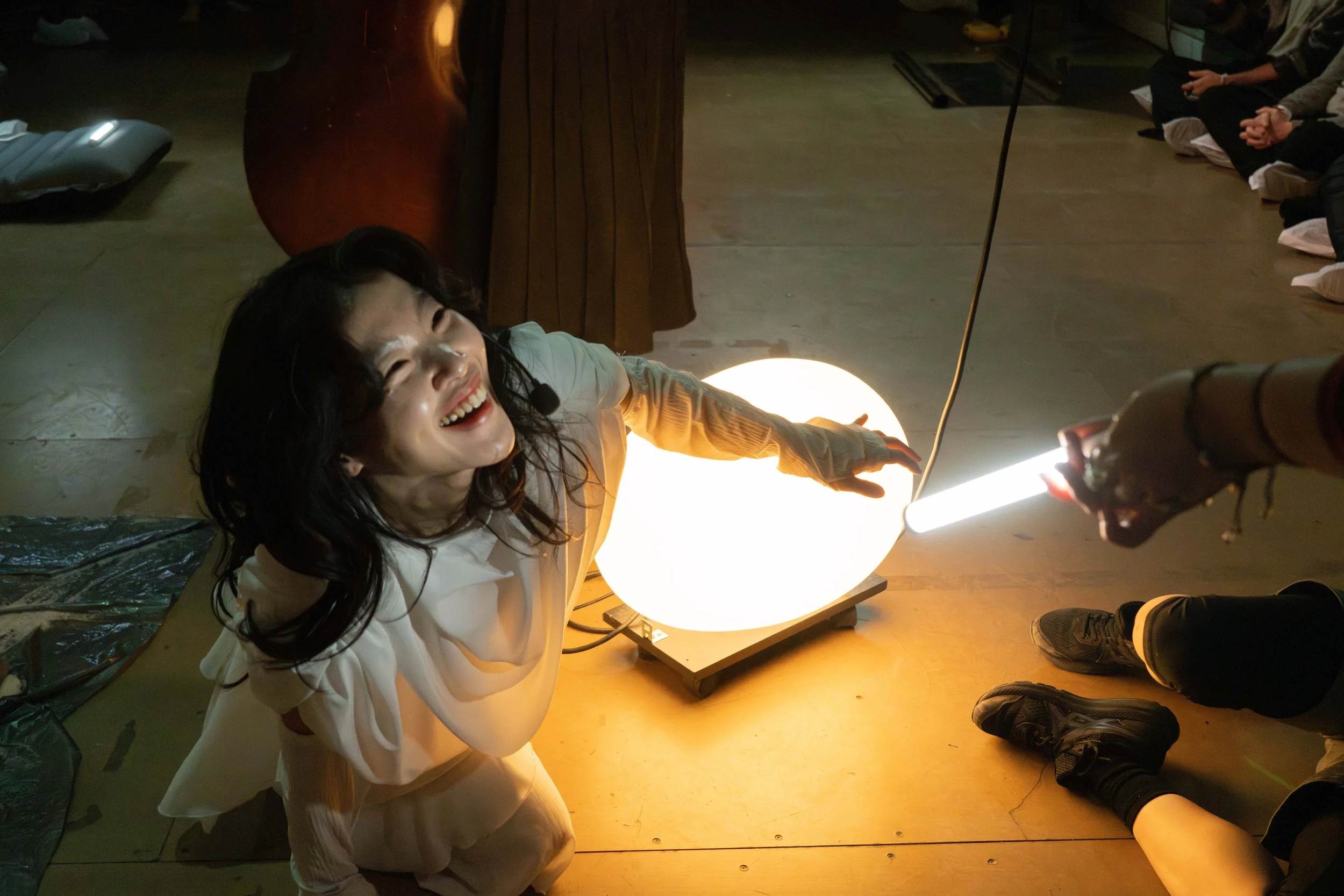
Photo by Ji Hoon Kim
The omnipresent sound, layered with effects and voices, or what we would call music, saturated the space. In that non-silence, I heard time. Time flowed through the multiverse, crossing language barriers, passing through speakers and equipment, transcending the physical constraints of performers and objects, yet flowing somewhat subjectively nonetheless.
Choi shared in our interview that she remembered a moment years ago when a foreign friend met her father, and despite speaking different languages, they still understood each other. “People move through different layers of perception, each a universe of its own, yet together they form a layered, multiversal world,” she said. On stage, performers and audience alike scatter, converge, and shift like atoms, and in that interplay, “we experience the cosmos itself.”
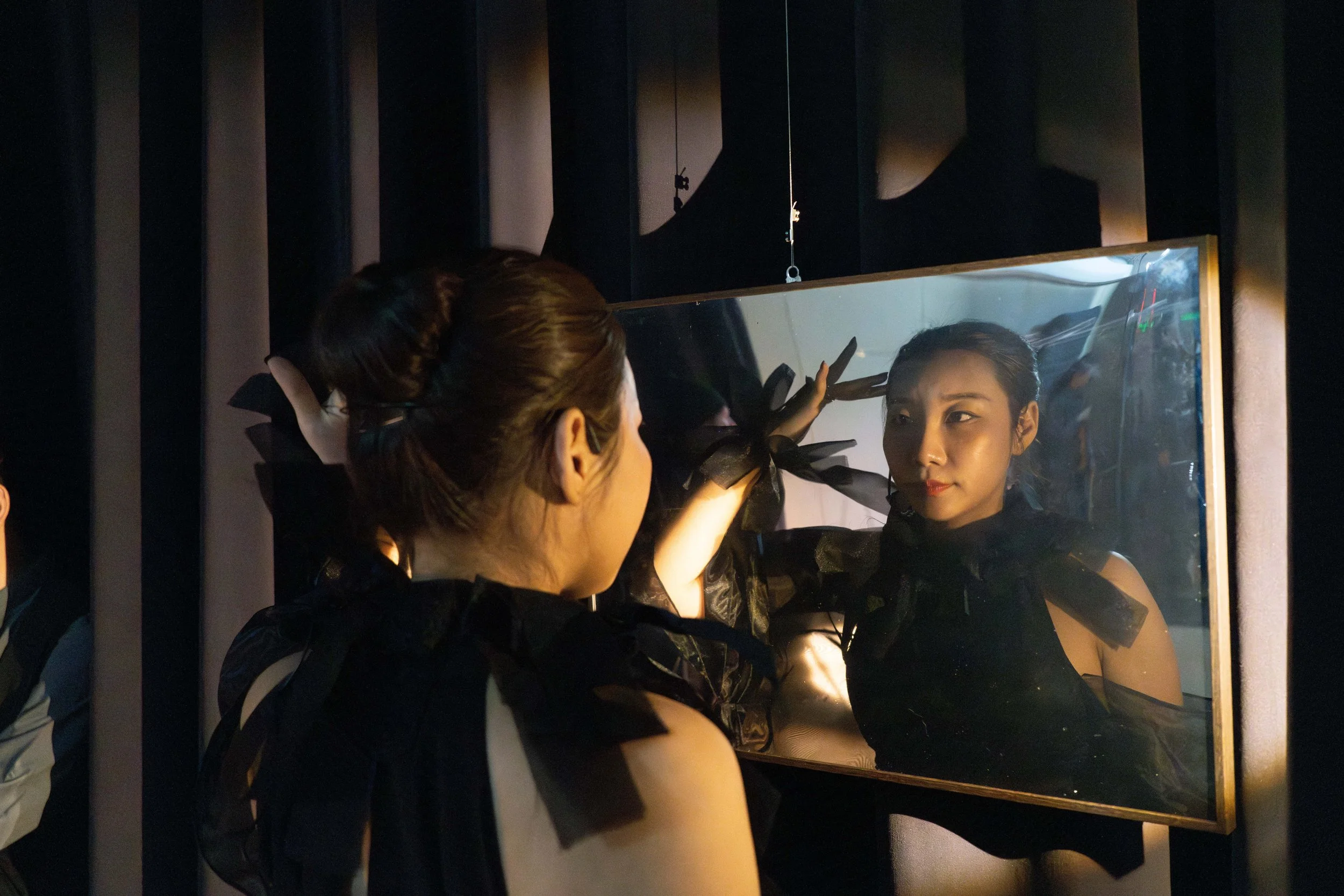
Photo by Ji Hoon Kim
We hear time in silence. We hear silence in time. During the performance, there was a moment when everyone fell silent. Nevertheless, it was difficult to tell whether this was truly silence, even as music, acting, movement, and objects were gradually stripped away. Just as it is impossible for time not to pass, space here could never be empty, nor could sound vanish entirely.
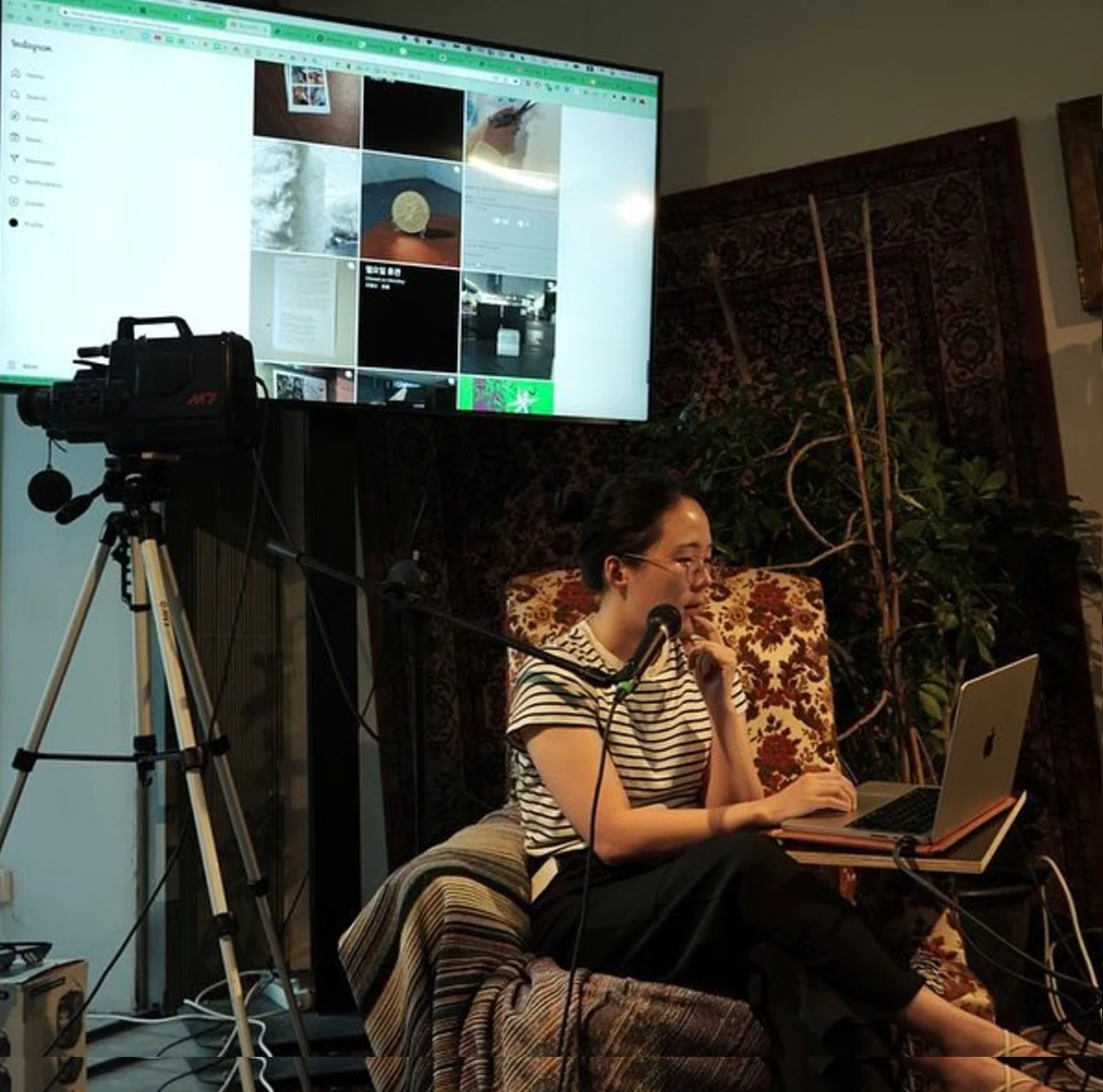
Min-hyung Kang (she/her) is a contemporary art curator and arts interpreter/translator working across English, Japanese, and Korean. She co-runs Forking Room, a platform that critically engages with art, technology, and society.