Choice, Chance, and Revolution
Michelle Santiago Cortés
Choice, Chance, and Revolution
Melanie Hoff and Ime Soul's Dance Poem Revolution
January 22, 2026
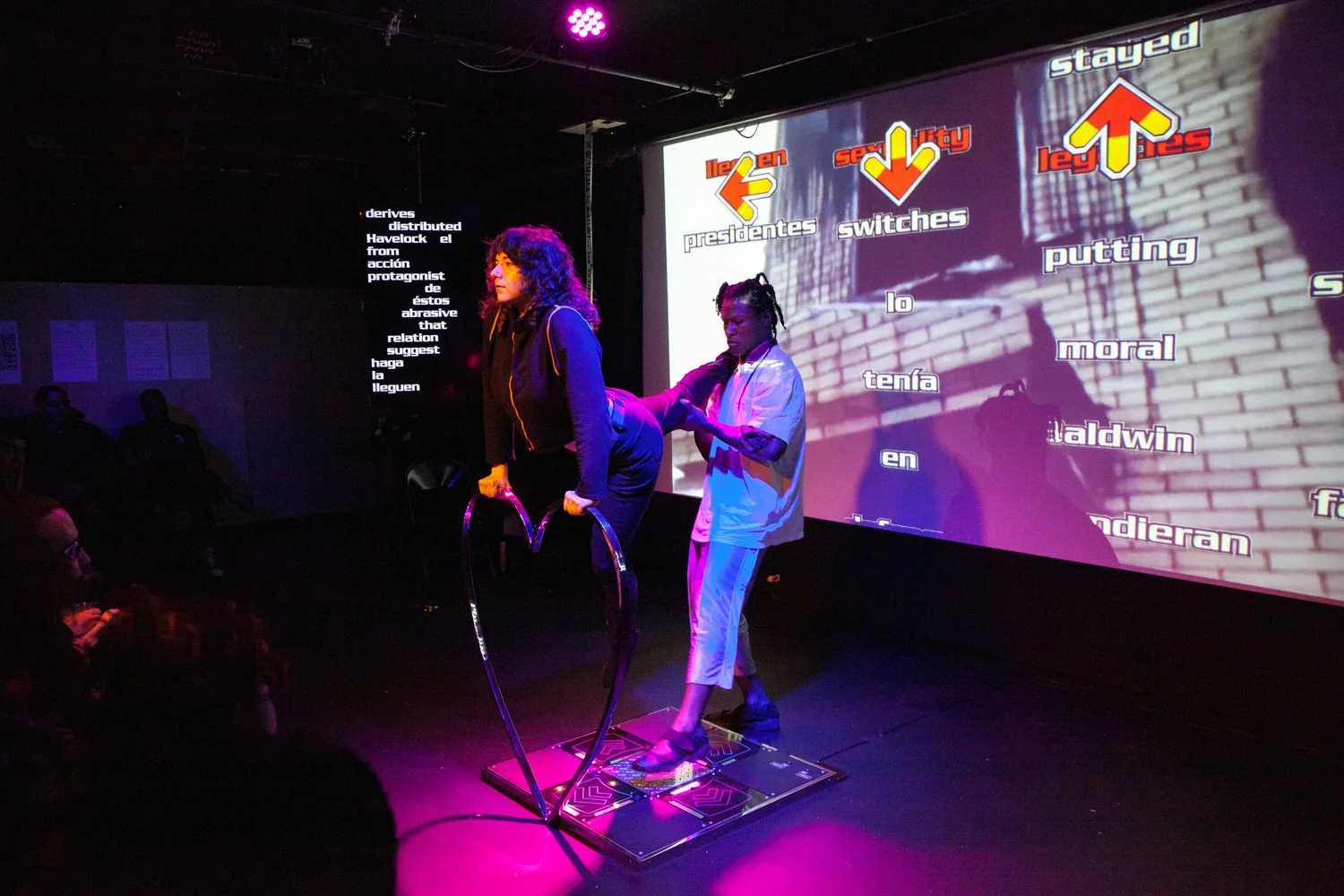
Photo by Olena Shkoda
Instead of the usual arcade choir of mechanical coin jingles and pixelated pew-pew sounds, the third floor at CultureHub’s Great Jones Street locale was calmed by Sam Cooke’s “It Won’t Be Very Long.” A projection covering the largest wall flitted through video footage -– For You Page-style -– that included “iconic” footage of MC Debra swishing hair across her forehead. I found myself trying recite her muted monologue: Let me give her a new style *swish* a new hairdo *swish* a new crop *swish* a new color… Words shaped by Dance Dance Revolution’s iconic Serpentine font scrolled over the images. Tonight, words like “caciquismo” and “pornocracia” floated over footage of Sergei Parajanov’s The Color of Pomegranates, an Etta James performance of “Rather Go Blind,” TikToks and newscast vigils reacting to the recent death Renee Nicole Good. Some were extracted from the captions, but most of them were taken from a dozen-or-so texts Melanie Hoff and their collaborator for the evening, Ime Soul, contributed to the corpus.
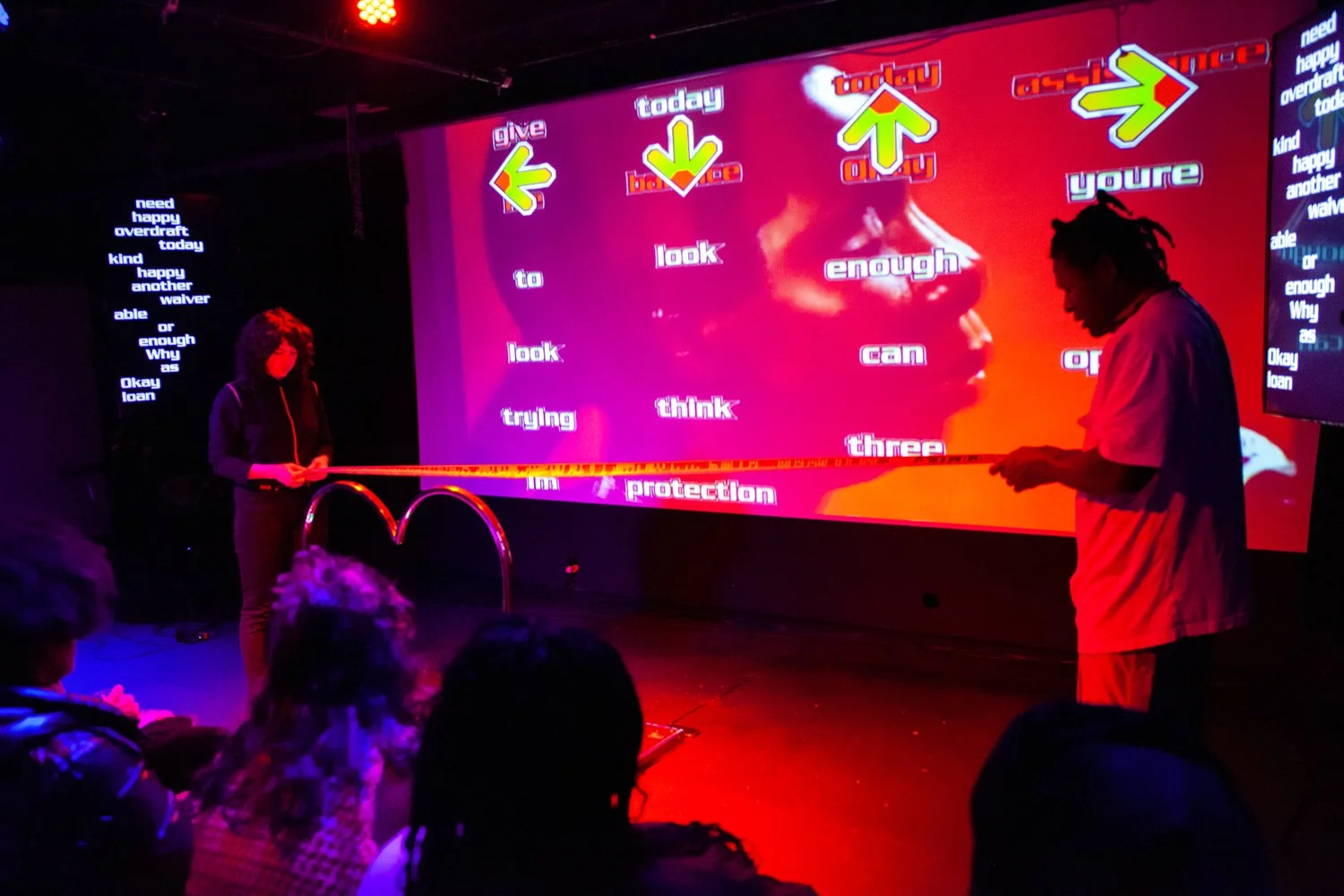
Photo by Olena Shkoda
Four streams of words floated up the screen in columns, sliding behind unreactive arrows. Like slot machine peaches, the arrows — left, up, down, and right — hang from the top of the screen, filled in with an orange-to-yellow gradient that explodes into a flash of white only when the player-author-artist standing in front of the screen times their steps just-so. After Hoff and Soul’s performance brought the game to life, the audience was welcomed to step onto the platform, grip the curves of the heart-shaped stand and step on the desired arrow tiles to write out poems using the words on the screen.
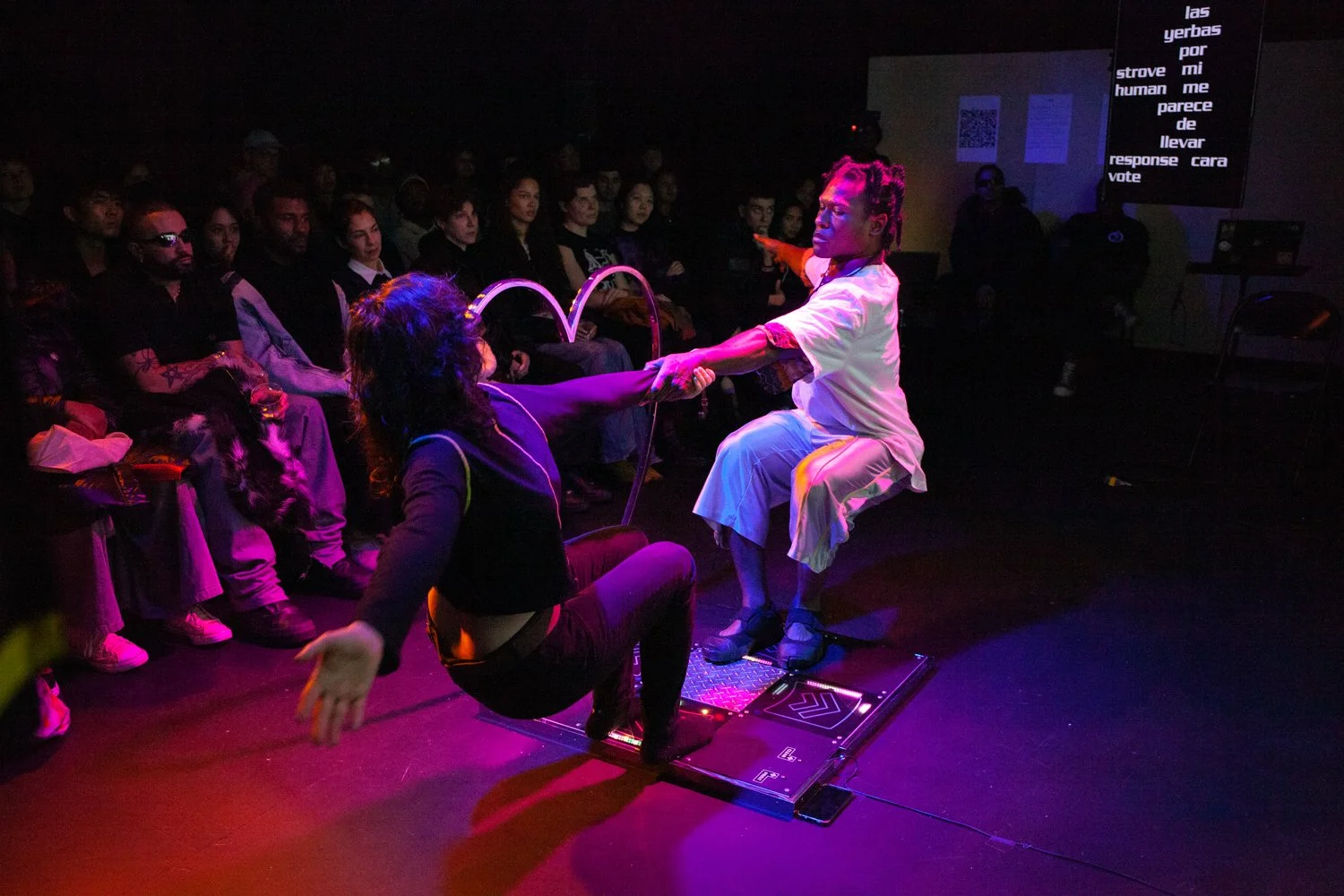
Photo by Olena Shkoda
In Hoff’s take on DDR, you play to the poem you are writing, not the music as it’s represented by arrows on the screen. Like a casino game, the soundscapes of Dance Poem Revolution are ambient and textural extensions of the game, and not integral to its mechanics or functionality. I heard sighs, moans, and church choir clips loop over the speakers, an oddly-soothing cacophony of Las Vegas sounds. I know it’s not totally flattering to compare Hoff’s Dance Poem Revolution, a game about poetry and revolution, to casinos and the common slot machine as it appears in sleepy bars and crowded casino floors. One is art and the other is a vice; one gives, the other extracts. But they are bonded by more than a play on words.
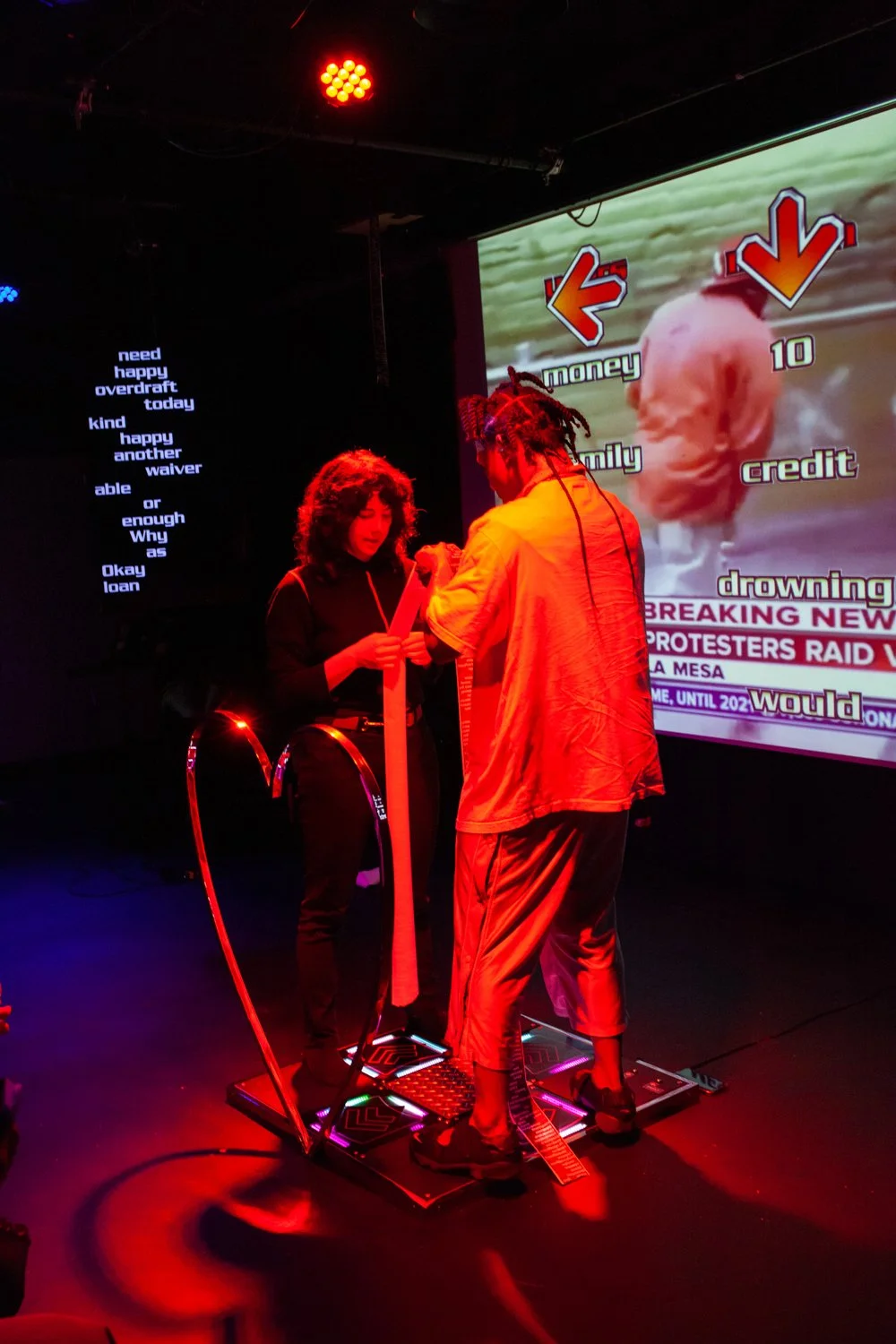
Photo by Olena Shkoda
The common slot machine employs representation of mechanical slot machine elements — the lever is usually a button and the wheels are images on a screen that, increasingly, forgoes the wheel entirely to display floating icons shifting along a grid. These separating degrees of representation conceal the game mechanics, skill recedes and the game becomes all chance and aesthetics. The interface compensates accordingly: Most slot machines these days are three-screens tall, arching over the player in a complementary — if not encroaching — curve.
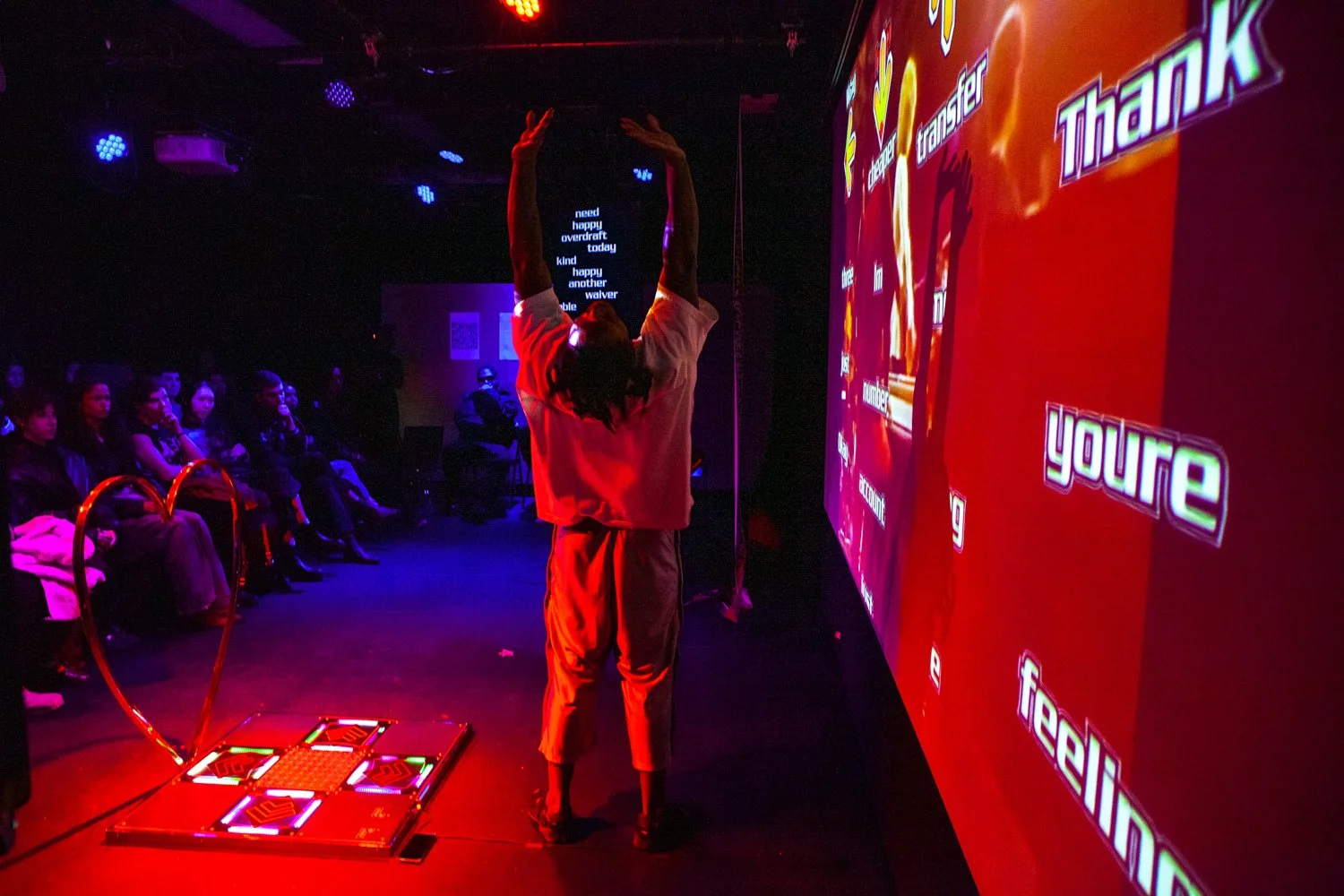
Photo by Olena Shkoda
These features enable players of these digitally networked slot machines to enter what Natasha Dow Schüll calls the “machine zone,” a state of machine enmeshment where “alterity and agency recede.” DDR’s interface is tighter: As a game, it’s much more skills-based than slots (although luck and chance aren’t entirely excluded from game play). Half the fun of DDR comes from entering or watching a player enter the machine zone, where limbs and tiles; eyes and screen icons become coextensive and enmeshed. But Dance Poem Revolution’s interface is even tighter, as the corpus of texts and images that populate the game are compiled by Hoff’s own collaborators based on how they "represent the idea of revolution within, of, and for__[place]__you,” according to Hoff’s invitation to sources gatherers. Choice meets chance at every level of the gameplay: The texts and images on the screen are co-curated by collaborators, a series of scripts that encourage randomization without abnegating responsibility, and the player is subsequently encouraged to put their weight behind their choices.
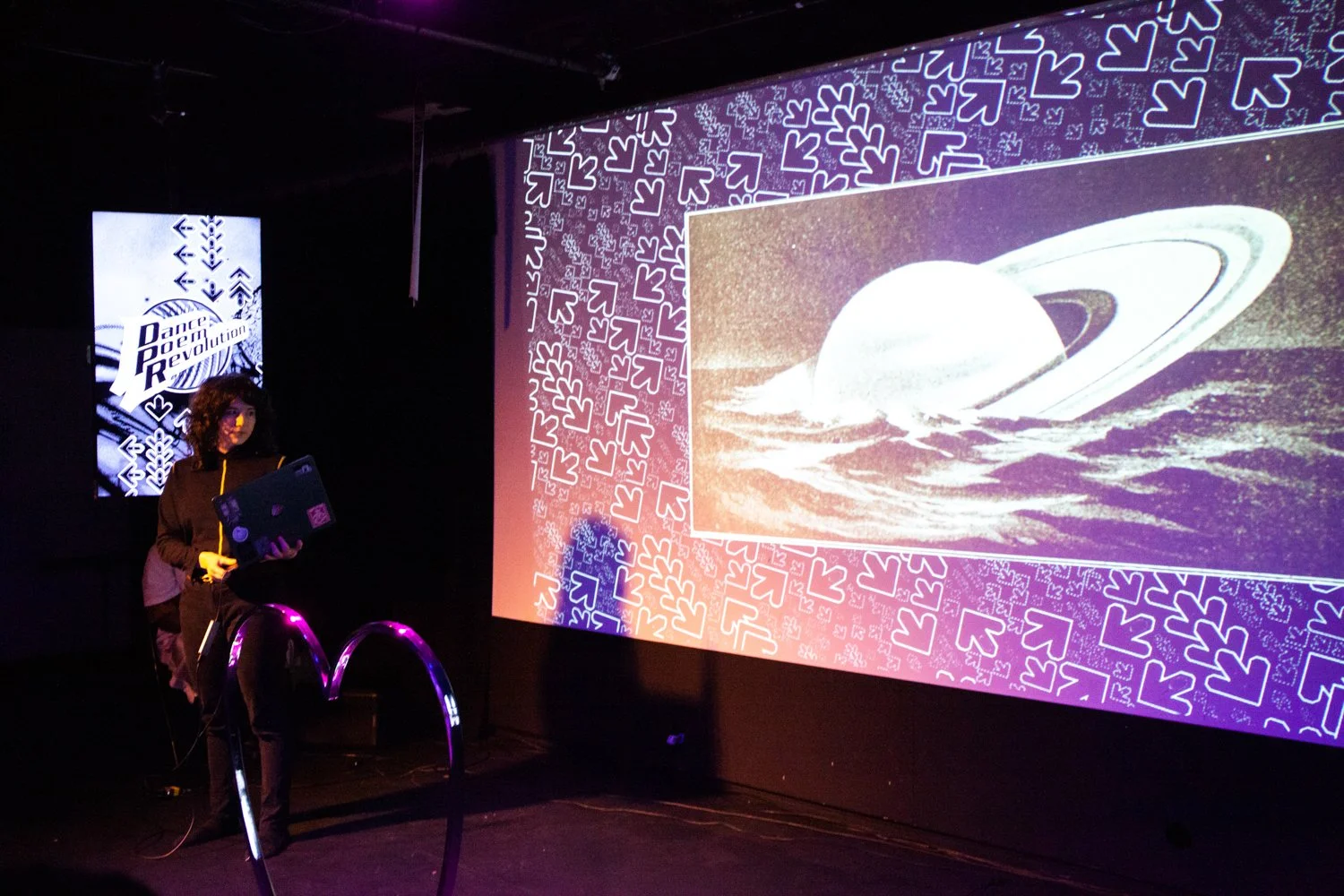
Photo by Olena Shkoda
In Dance Poem Revolution’s machine zone, alterity and agency are encouraged to spiral around each other. Hoff stands on the game’s platform in front of a projection of Saturn and its ring and declares: “I let myself be guided by the tension of the spiral.” Revolution, they add, can consist of “a million acts of revolt, sometimes careening, falling, failing, freeing.” Struggle is a series of failed revolutions, one rotation after another, an unrelenting process of failure and remixing. It’s a good reminder that revolution is not a singular, climactic event, but a long chain of efforts and failures.
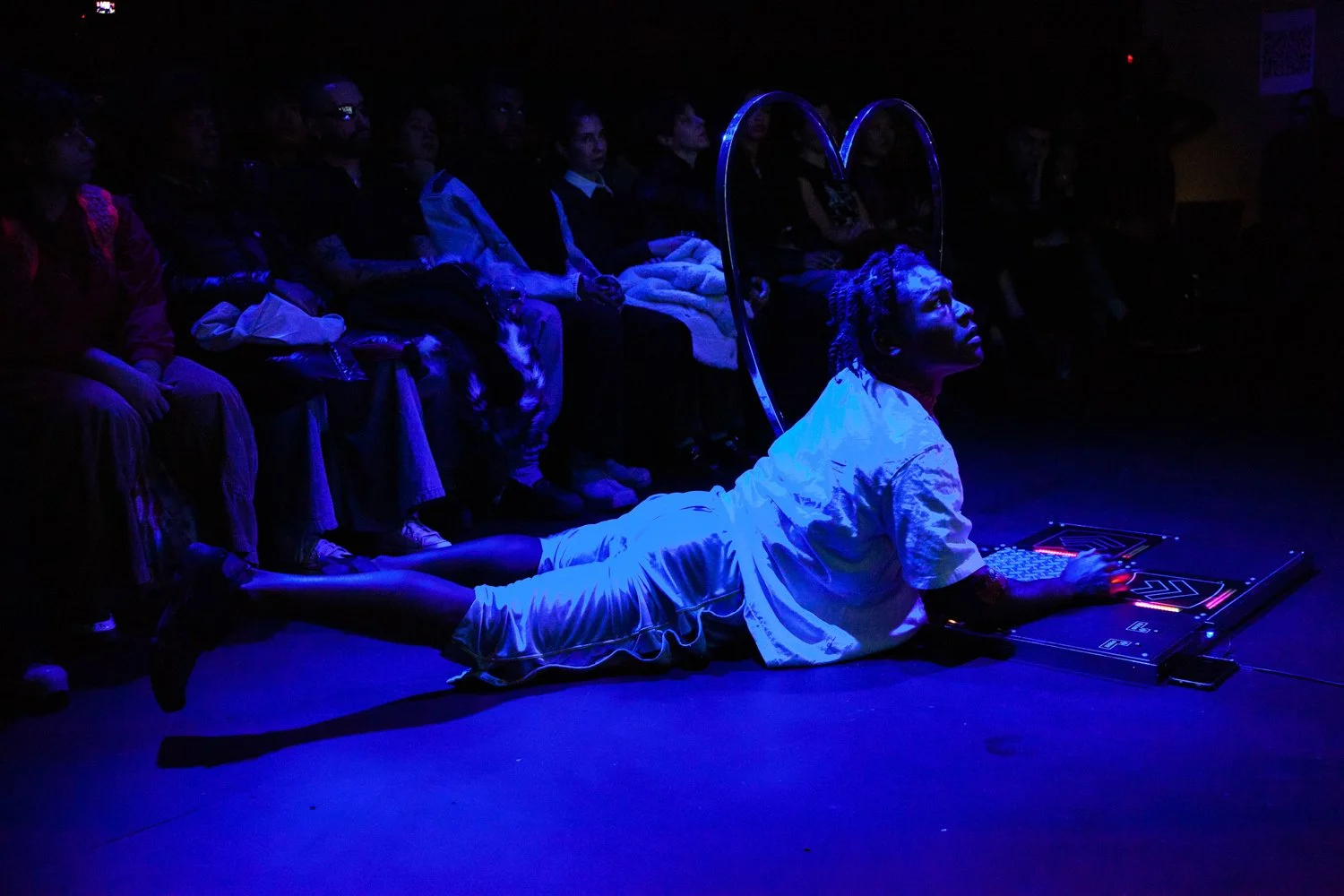
Photo by Olena Shkoda
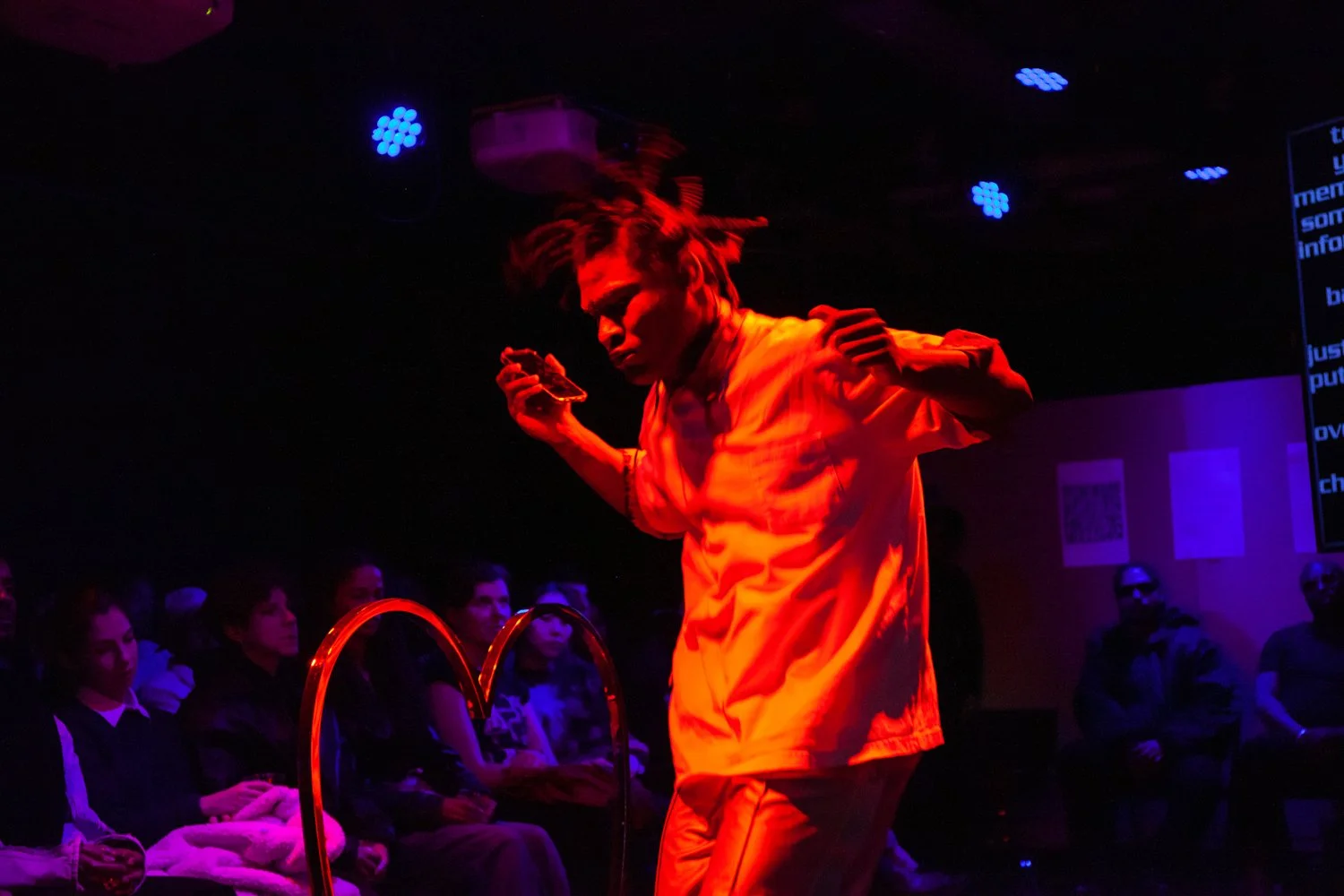
Photo by Olena Shkoda
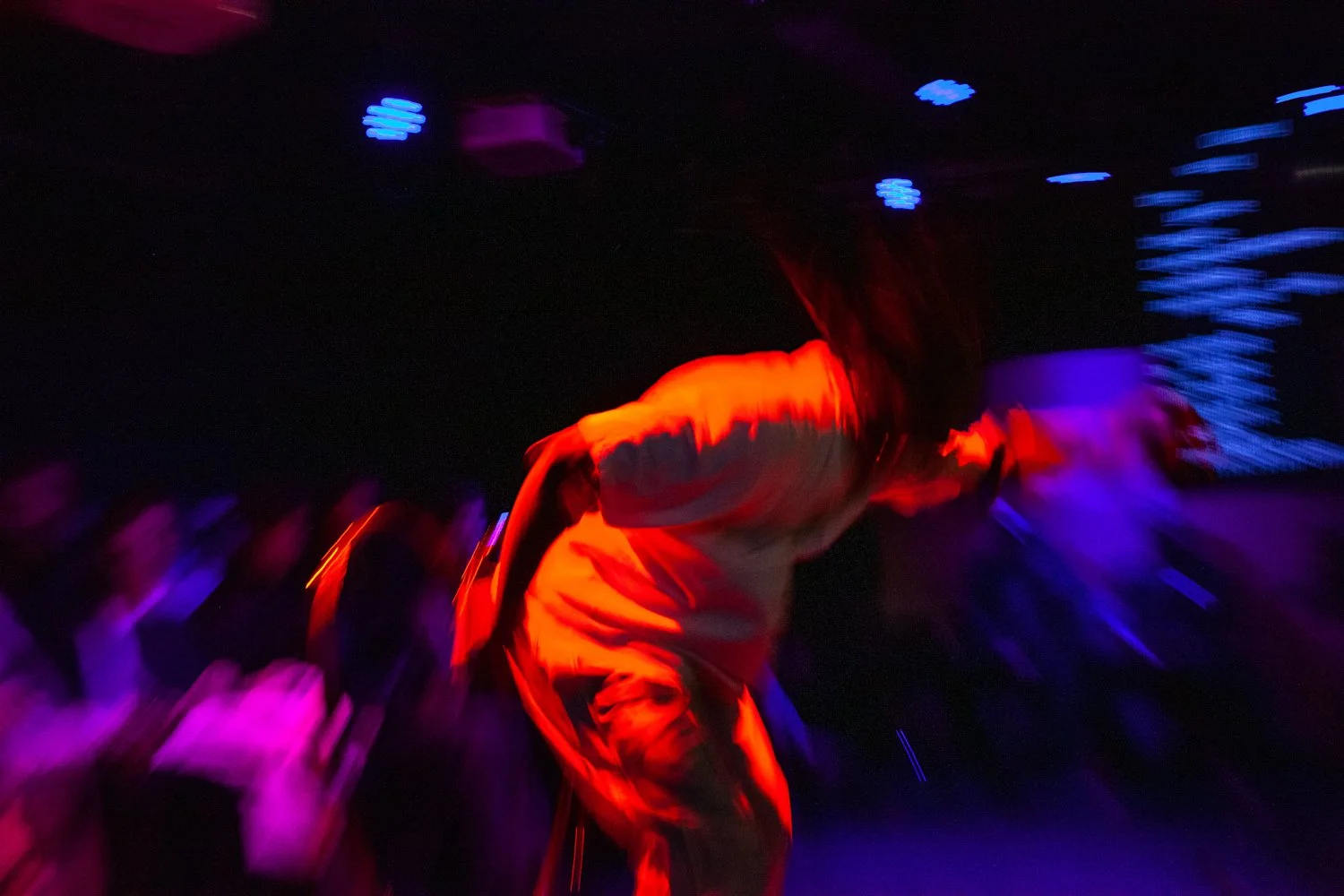
Photo by Olena Shkoda
The future, already subject to absurd levels of capitalist capture, is at risk of further foreclosure by predictive algorithms and gamification thanks to the latest trends in prediction market mania, as heralded by platforms like Kalshi and Polymarket. Ime’s solo portion revolves around a distressing phone call between the artist and their bank. The artist is asking for overdraft fee waivers and the person on the other line is encouraging them to open a new line of credit. Extreme financialization has pulled everything, including access to basic necessities and vital resources, into the speculative marketplace. The task at hand requires us to reckon with the differences between dreaming from the gambling, the gameplay loop from the revolution.
Michelle Santiago Cortés is a writer and editor from San Juan, Puerto Rico. She writes about art, culture, technology, and life online.